
Life Model Forest
Model care for diverse forest habitats and the species linked to them, in cooperation with forest owners, site managers, regions, municipalities and volunteers.
About the project
Improving the conservation status of priority forest habitats and species across targeted Natura 2000 sites, while engaging owners, managers, regions, municipalities and volunteers.
- Low species and age diversity
- Shortage of veteran trees and deadwood
- Spread of invasive alien species (IAS)
- Low awareness among stakeholders and the public
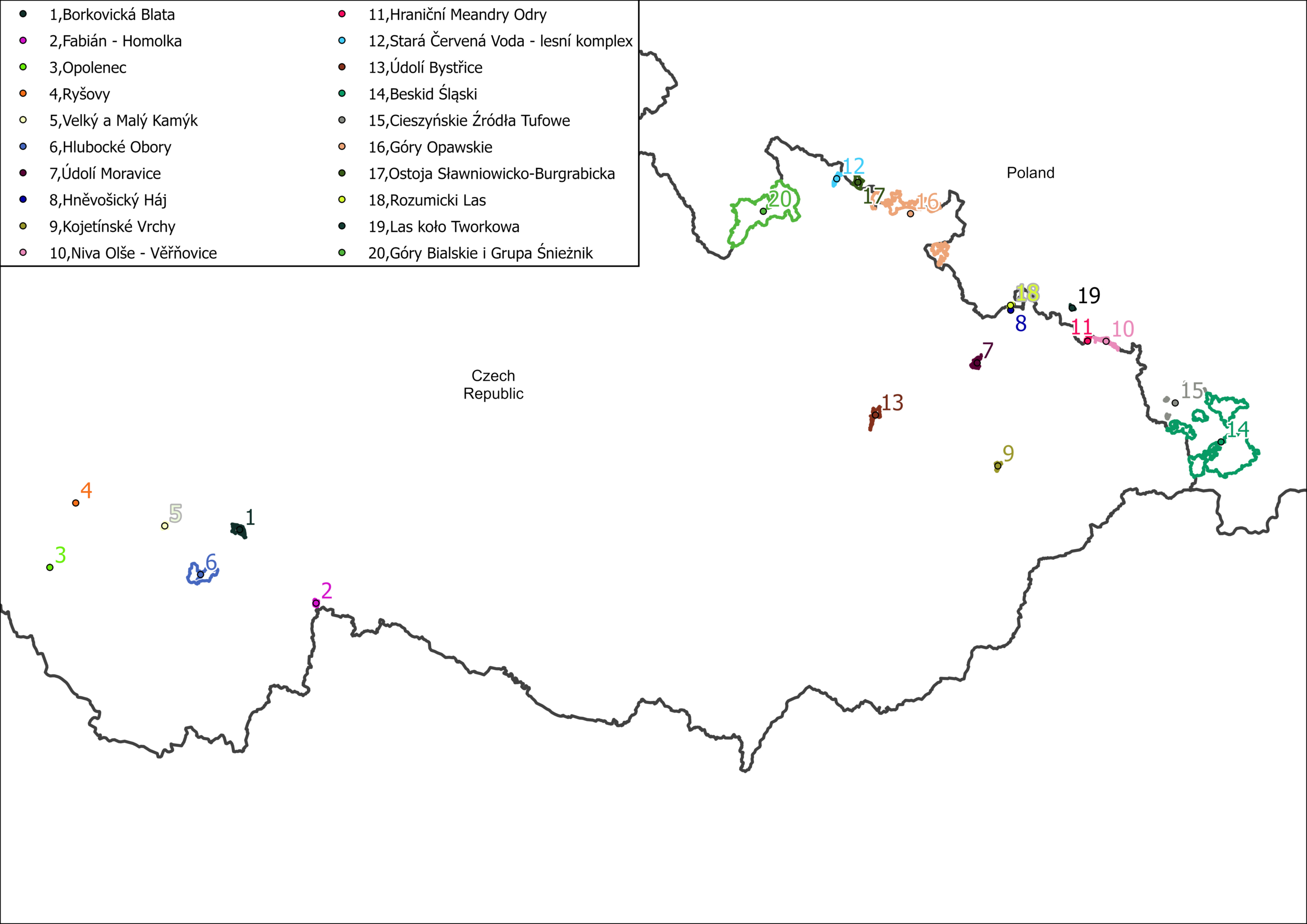
Scale: 19 km² of habitat areas (approximately one-third priority) plus 36 km² of species-focused management.
Project in the media
The project and its volunteer activities were featured by Czech Television in Události v regionech – Ostrava. The report presents practical volunteer activities connected with the care of protected sites.
▶ Watch the report on Czech TelevisionProject News & Stories
Explore news about LIFE Model Forest, conservation work, environmental education, partner activities and related stories. Articles are published in Czech by ČSOP ONYX.
A related story celebrating commitment to nature and landscape restoration.
Read story ↗ LIFE Model Forest field visit in the Silesian BeskidsProject partners visit a Natura 2000 locality to exchange practical experience.
Read article ↗ Discovering nature in the Silesian BeskidsSchoolchildren discover biodiversity through an outdoor educational excursion.
Read article ↗📚 Browse all news articles
Nature, Fieldwork & Conservation
Environmental Education & Community
People, Partnerships & Related Stories
- 01 Vilém Jurek recognised for landscape conservation ↗
- 04 Veronika Skorokhod: From Kyiv to Czech forests ↗
- 12 Veronika Skorokhod’s story and new mission ↗
- 14 LIFE Model Forest at the Internationalisation Academy ↗
- 17 First project partners’ meeting in Ostrava ↗
- 18 Petrklíč Help launches volunteer recruitment ↗
Article numbers follow the supplied list, newest first. Some items are related environmental stories rather than direct LIFE Model Forest project reports. Source: ČSOP ONYX.
Actions & Work Packages
C1 · Habitat restoration
C2 · Invasive alien species & four-language methodology
D1 · Monitoring & indicators
E1 · Stakeholder & volunteer engagement
E2 · Communication, replication & After-LIFE
Target Habitats & Species
Habitats: 91D0*, 91E0*, 9180, 9110, 9130, 9170, 9190, 91F0, 91T0, 91U0, 7140.
Species: Osmoderma eremita, Callimorpha quadripunctaria, Gentianella bohemica, Limoniscus violaceus, Lucanus cervus, Cucujus cinnaberinus, Rhyzodes sulcatus, Carabus variolosus, Bombina variegata, Bombina bombina, Triturus cristatus, Dicranum viride.
Ambassadors of Natura 2000 Sites
Educational institutions and community organisations supporting nature conservation awareness, education and engagement around Natura 2000 sites.






Volunteer with us
Help with habitat restoration, invasive alien species control and monitoring during field days (spring–autumn). Training and safety briefings are provided.
🤝 Become a volunteer